Game
Application settings open in the main view via the Settings tab in the top navigation (or the cogwheel icon on the right side of the top bar). Navigation lives in the left sidebar, grouped by topic, with a search field at the top that finds any setting by name and jumps straight to it.
Changes are collected as you edit — an Unsaved changes indicator with Save and Discard actions appears in the toolbar whenever your edits differ from the stored configuration. Nothing is applied until you save. Switching to another main tab while edits are pending opens a You have unsaved settings prompt with three actions: Ignore leaves the tab with your edits still pending, Save saves them and then leaves, and Discard Changes reverts them and then leaves. Moving between pages inside Settings never prompts. Ignored edits survive switching to another main tab and back, and while they are pending the Settings tab in the top navigation shows a warning badge, so the state stays visible even after you switch to another tab.
If the configuration is changed elsewhere while you have unsaved edits — from another window, or by the help agent — a Changed outside this view — saving overwrites warning appears in the toolbar instead of your edits being silently overwritten (or silently overwriting the other change). Discard loads the latest stored configuration; Save overwrites the outside change with your edits.
The Game group holds general game behavior and the default player character.
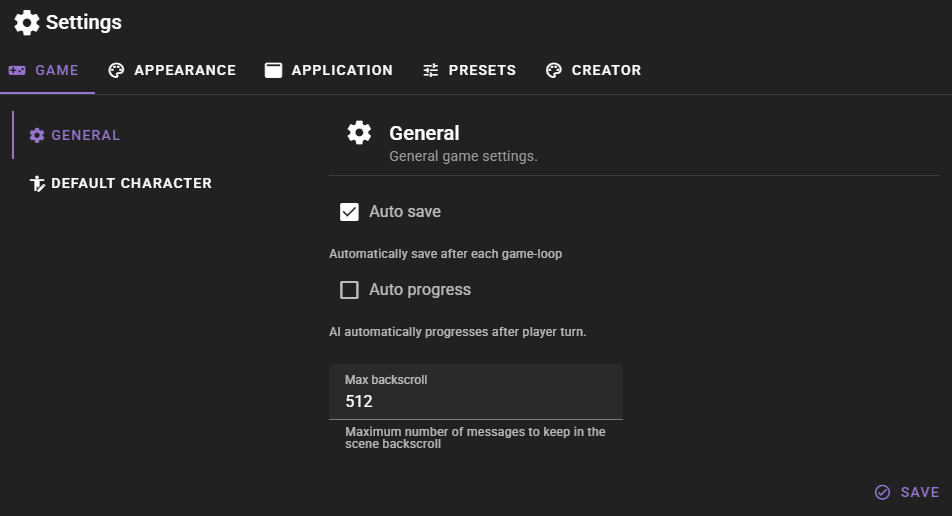
General
Auto save
If enabled the scene will save everytime the game loop completes. This can also be toggled on or off directly from the main screen.
If a scene is set to be immutable, this setting will be disabled.
Auto progress
If enabled the game will automatically progress to the next character after your turn. This can also be toggled on or off directly from the main screen.
Max backscroll
The maximum number of messages that will be displayed in the backscroll. This is a display only setting and does not affect the game in any way. (If you find your interface feels sluggish, try reducing this number.)
Show agent activity bar
When enabled, a horizontal bar appears above the scene tools showing which agents are currently working. Each active agent is displayed as a small chip with the agent's name and its current action. This provides visibility into background processing without needing to check the system bar at the top of the screen.
This setting is enabled by default.
Release GPU cache on scene load
When enabled, idle GPU memory reserved by local CUDA embeddings or TTS is handed back to the driver when switching scenes, so it doesn't pile up and eventually leave too little VRAM to load another scene. Disable only if you have VRAM to spare and would rather keep it reserved.
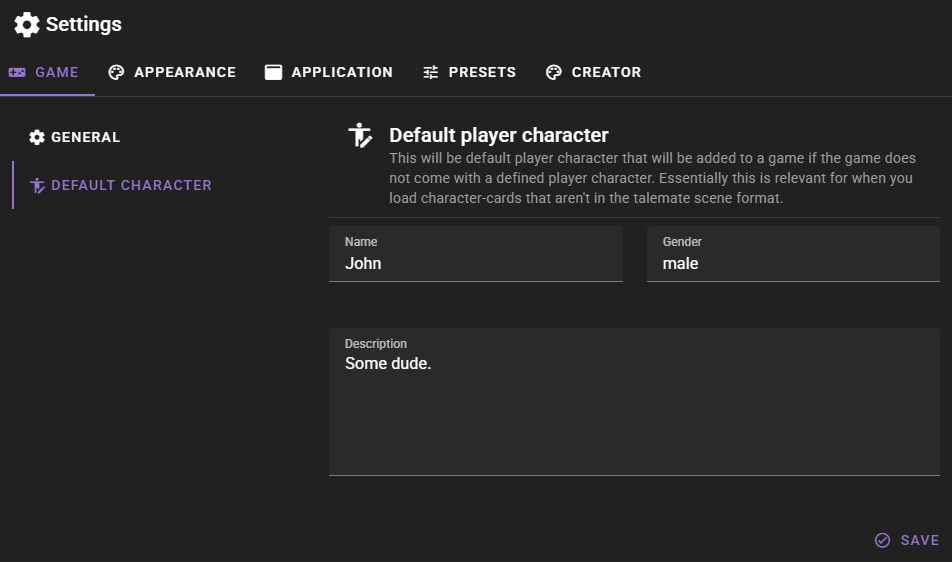
Player Character
Lets you manage a basic default character.
This character is used when a scene is loaded that does not define a player character. Mostly relevant when you load character-cards that aren't in the talemate scene format (e.g., ST character cards).
Add default character to blank talemate scenes
When creating a new scene, add the default player character to the scene.