OpenRouter
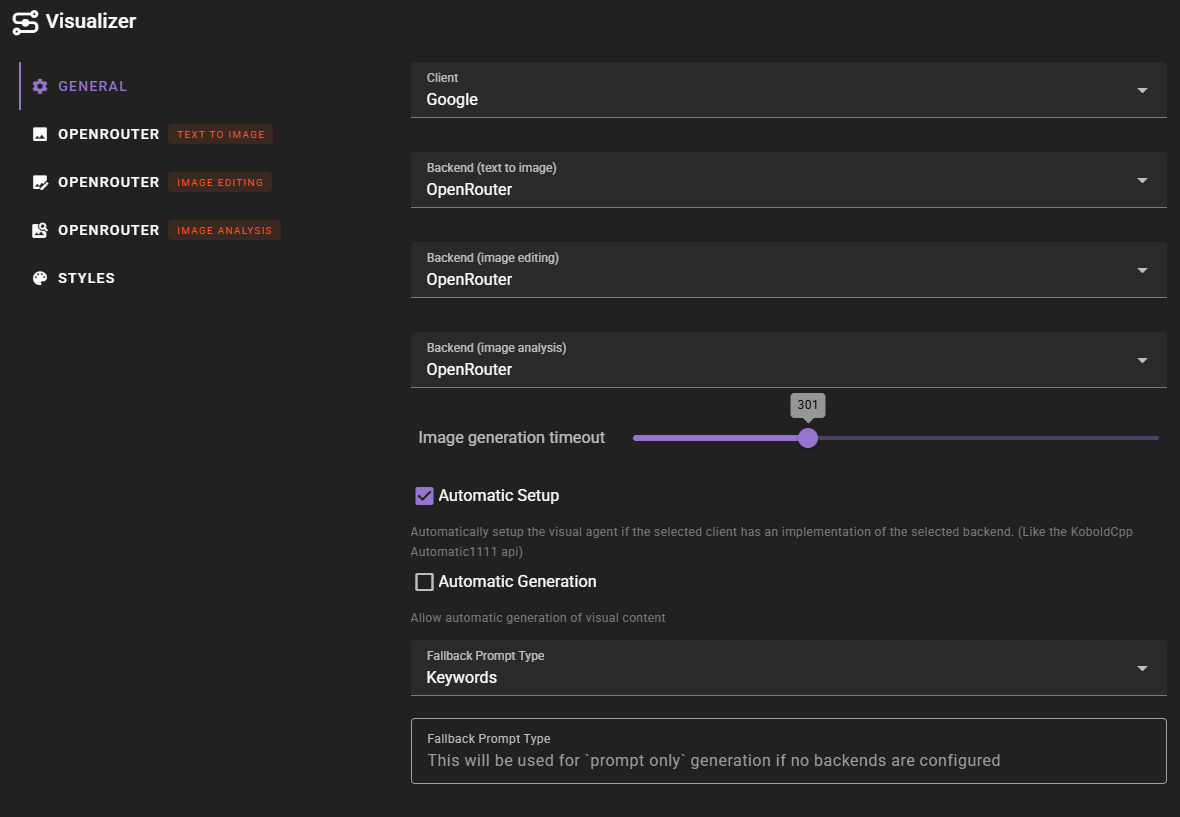
The OpenRouter backend provides access to image generation, editing, and analysis capabilities through OpenRouter's unified API. OpenRouter allows you to access multiple AI providers through a single API, giving you flexibility to choose from various models and providers.
Prerequisites
Before configuring the OpenRouter backend, you need to obtain an OpenRouter API key:
- Go to OpenRouter Keys
- Sign in with your account
- Create a new API key or use an existing one
- Copy the API key
Then configure it in Talemate:
- Open Talemate Settings → Application → OpenRouter API
- Paste your OpenRouter API key in the "OpenRouter API Key" field
- Save your changes
For additional instructions, see the OpenRouter API setup guide.
Configuration
In the Visualizer agent settings, select OpenRouter as your backend for text-to-image generation, image editing, image analysis, or any combination of these. Each operation can be configured separately.
Text-to-Image Configuration
For text-to-image generation, configure the following settings:
- OpenRouter API Key: Your OpenRouter API key (configured globally in Talemate Settings)
- Model: Select an image generation model from OpenRouter. The model list is dynamically populated based on models available through your OpenRouter account.
- Only use these providers: Optionally filter to specific providers (e.g., only use Google or OpenAI)
- Ignore these providers: Optionally exclude specific providers from consideration
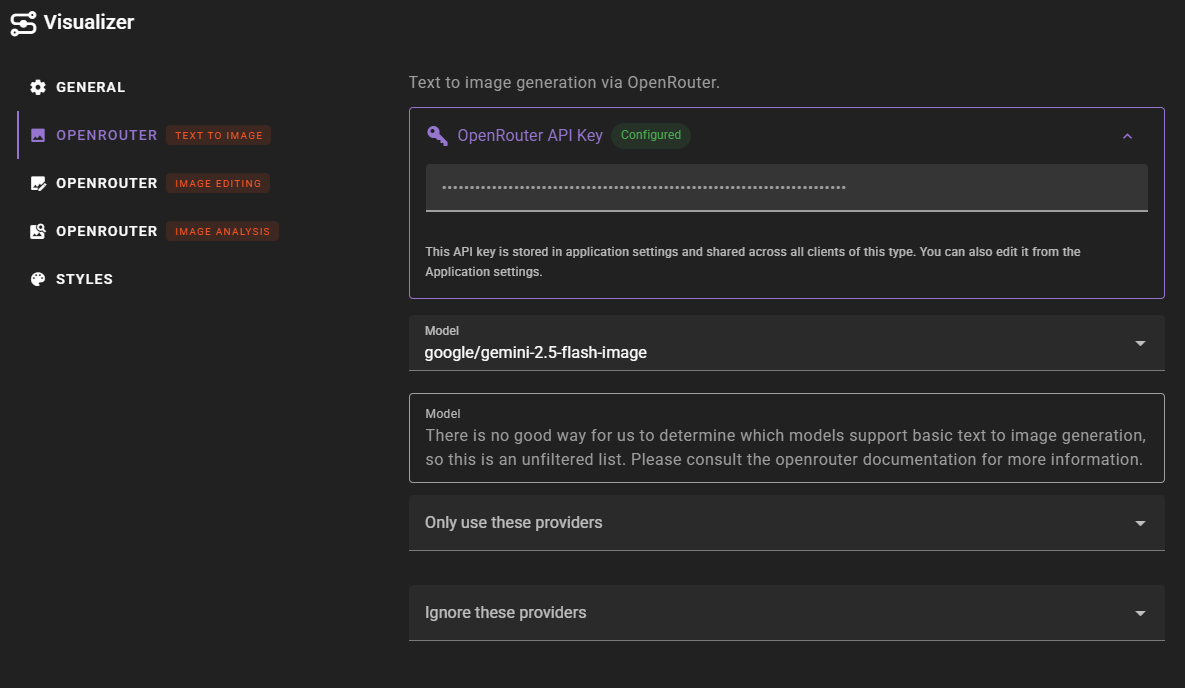
Model Selection
There is no reliable way for Talemate to determine which models support text-to-image generation, so the model list is unfiltered. Please consult the OpenRouter documentation to verify that your selected model supports image generation before using it.
The OpenRouter backend automatically handles aspect ratios based on the format you select:
- Landscape: 16:9 aspect ratio
- Portrait: 9:16 aspect ratio
- Square: 1:1 aspect ratio
Image Editing Configuration
For image editing, configure similar settings with an additional option:
- OpenRouter API Key: Your OpenRouter API key
- Model: Select an image editing model from OpenRouter
- Max References: Configure the maximum number of reference images (1-3). This determines how many reference images you can provide when editing an image.
- Provider filtering: Optionally filter providers (same as text-to-image)
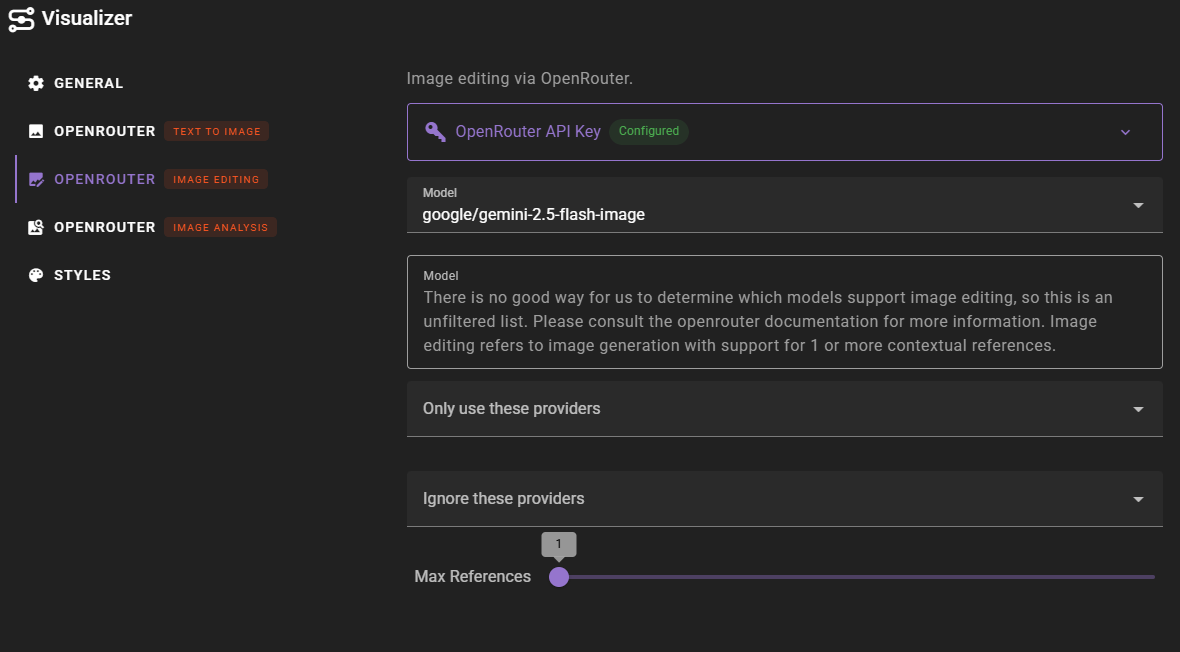
Model Selection
There is no reliable way for Talemate to determine which models support image editing, so the model list is unfiltered. Image editing refers to image generation with support for 1 or more contextual reference images. Please consult the OpenRouter documentation to verify that your selected model supports image editing before using it.
Image Analysis Configuration
For image analysis, configure the following:
- OpenRouter API Key: Your OpenRouter API key
- Model: Select a vision-capable text model from OpenRouter
- Provider filtering: Optionally filter providers

Model Selection
There is no reliable way for Talemate to determine which models support image analysis, so the model list is unfiltered. Image analysis requires a text generation model that is multi-modal and supports vision capabilities. Please consult the OpenRouter documentation to verify that your selected model supports vision before using it.
Usage
Once configured, the OpenRouter backend will appear in the Visualizer agent status with green indicators showing which capabilities are available.

The status indicators show:
- Text to Image: Available when text-to-image backend is configured
- Image Edit: Available when image editing backend is configured (shows max references if configured)
- Image Analysis: Available when image analysis backend is configured
Model Recommendations
OpenRouter provides access to many models from different providers. Here are some general recommendations:
Text-to-Image and Image Editing
- google/gemini-2.5-flash-image: Fast image generation with good quality
- google/gemini-3-pro-image-preview: Higher quality option (if available)
Image Analysis
- google/gemini-2.5-flash: Fast analysis with good accuracy
- google/gemini-2.5-pro: Higher quality analysis
- google/gemini-3-pro-preview: Latest capabilities (if available)
Provider Filtering
OpenRouter allows you to filter which providers are used for a specific model. This can be useful if:
- You want to use a specific provider for cost or quality reasons
- You want to avoid certain providers
- You want to test different providers for the same model
You can configure provider filtering in each backend's settings:
- Only use these providers: Limits requests to only the selected providers
- Ignore these providers: Excludes the selected providers from consideration
If both are configured, "Only use these providers" takes precedence.
Prompt Formatting
The OpenRouter backend uses Descriptive prompt formatting by default. This means prompts are formatted as natural language descriptions rather than keyword lists. Provide detailed, natural language descriptions of what you want to create or edit.