Mistral.ai Client
If you want to add an Mistral.ai client, change the Client Type to Mistral.ai.
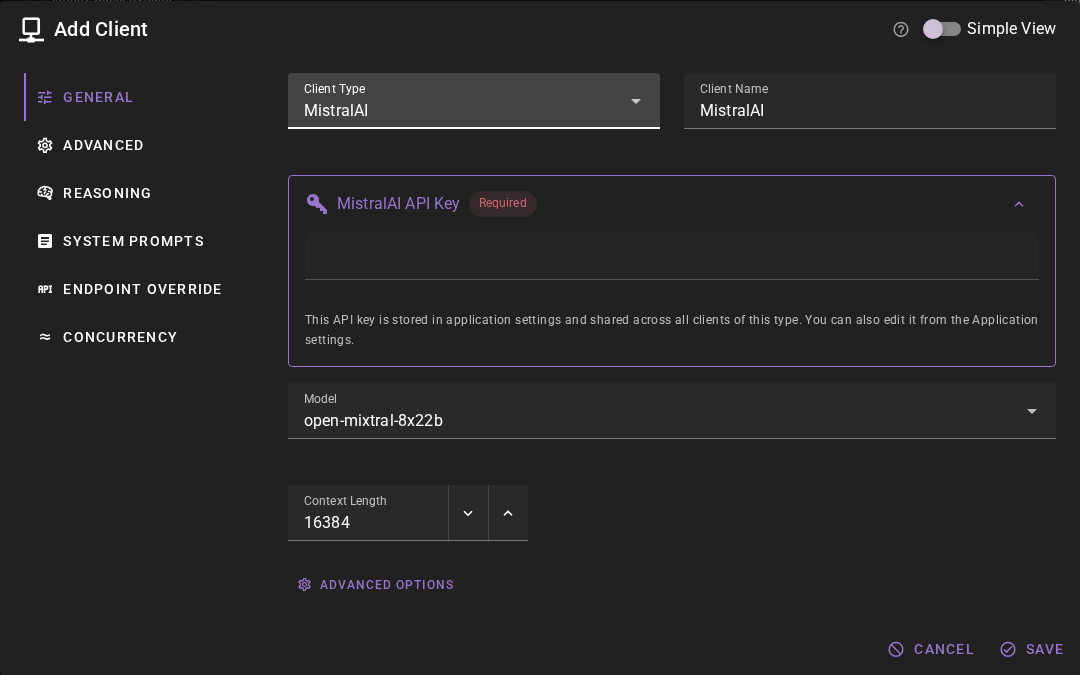
Click Save to add the client.
Mistral.ai API Key
The client should appear in the clients list. If you haven't setup Mistral.ai before, you will see a warning that the API key is missing.
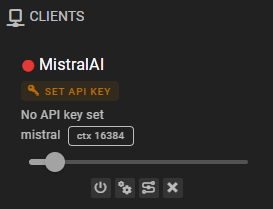
Click the SET API KEY button. This will open the application settings on the API Keys page where you can add your Mistral.ai API key.
For additional instructions on obtaining and setting your Mistral.ai API key, see Mistral.ai API instructions.

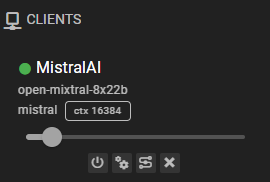
Click Save and after a moment the client should have a green dot next to it, indicating that it is ready to go.
Ready to use
Settings
Client Name
A unique name for the client that makes sense to you.
Model
Which model to use. Currently defaults to mixtral-8x22.
Talemate lags behind Mistral.ai
When Mistral.ai adds a new model, it may take a Talemate update to add it to the list of available models. However, you can always manually enter any model name in the model field if you know the exact model identifier.
Context Length
Maximum context length (in tokens) for generations sent to Mistral.ai. If you are not sure, leave the default value.
Concurrent Inference
Found under the Concurrency tab in the client settings. When enabled, batch operations that need several queries (currently visual prompt generation for image generation) can send multiple requests to the Mistral.ai API in parallel instead of one at a time, which can speed those operations up.
This is off by default. Whether concurrent requests actually complete in parallel depends on your Mistral.ai account's rate limits. See the Concurrent Requests page for more detail.
Response Length Enforcement
Controls whether token limits and/or human-readable response length instructions are sent with prompts. Defaults to Limit tokens and send instructions.
See Response Length Enforcement for details.