OpenRouter Client
If you want to add an OpenRouter client, change the Client Type to OpenRouter.
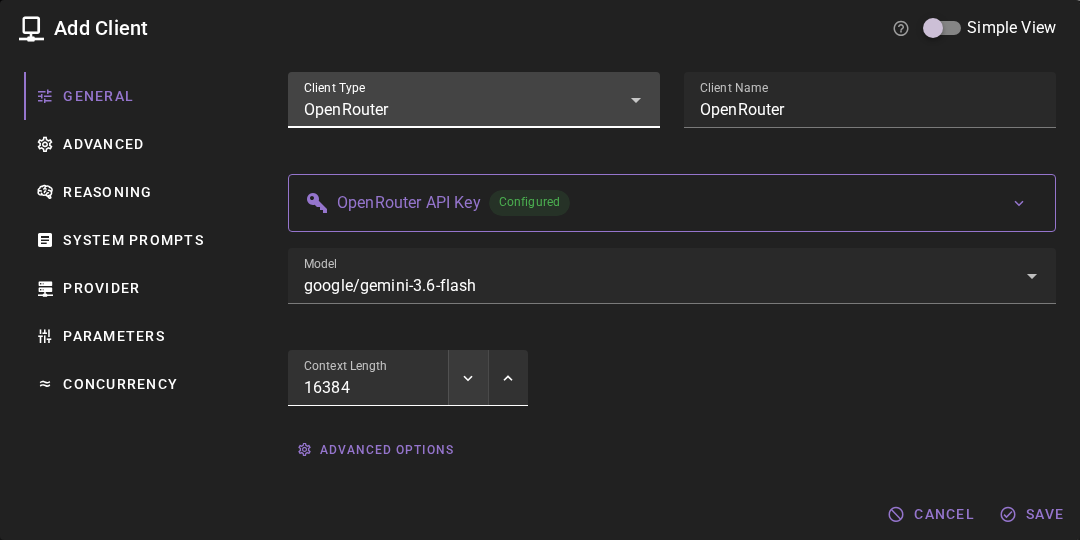
Click Save to add the client.
OpenRouter API Key
The client should appear in the clients list. If you haven't set up OpenRouter before, you will see a warning that the API key is missing.
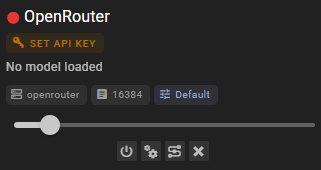
Click the SET API KEY button. This will open the application settings on the API Keys page where you can add your OpenRouter API key.
For additional instructions on obtaining and setting your OpenRouter API key, see OpenRouter API instructions.

Click Save and after a moment the client should have a red dot next to it, saying that there is no model loaded.
Click the icon to open the client settings and select a model.
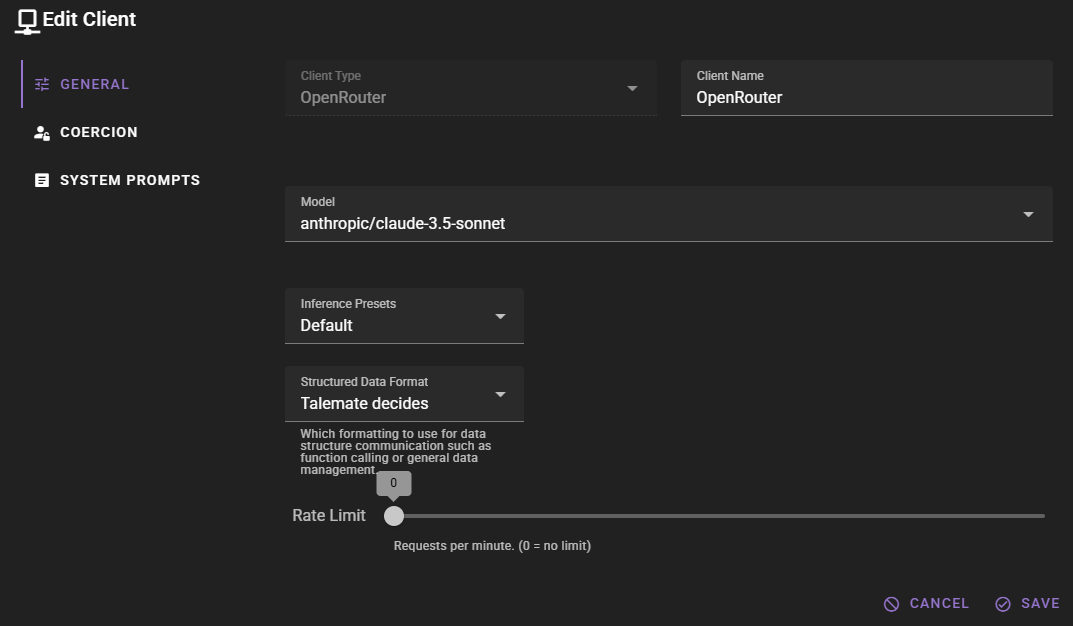 .
.
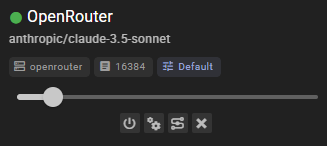
Click save and the client should have a green dot next to it, indicating that it is ready to go.
Ready to use
Settings
Client Name
A unique name for the client that makes sense to you.
Model
Choose any model available via your OpenRouter account. Talemate dynamically fetches the list of models associated with your API key so new models will show up automatically.
Context Length
Maximum context length (in tokens) that OpenRouter should consider. If you are not sure leave the default value.
Available models are fetched automatically
Talemate fetches the list of available OpenRouter models when you save the configuration (if a valid API key is present). If you add or remove models to your account later, simply click Save in the application settings again to refresh the list.
Parameters
The Parameters tab in the client settings lets you control which sampler parameters are sent with each request. Some model providers on OpenRouter reject requests that include parameters they don't support for the selected model, returning an error instead of a generation. If you run into this, you can turn the offending parameter off so it is left out of the request entirely.
Each parameter has its own toggle:
- Send temperature
- Send top_p
- Send top_k
- Send min_p
- Send frequency_penalty
- Send presence_penalty
- Send repetition_penalty
All of them are enabled by default. Turning a toggle off omits that parameter from the request completely (it is not sent as a zero value). Leave them enabled unless the provider serving your model errors when it receives one of them — for example, some providers only accept a frequency_penalty or presence_penalty of exactly 0 for certain models.
Response Length Enforcement
Controls whether token limits and/or human-readable response length instructions are sent with prompts. Defaults to Limit tokens and send instructions.
See Response Length Enforcement for details.